Married to ideology / divorced from people
All theory, no praxis.
Toward a Grounded Decolonial Materialism
The parallel failures of nationalist organising in Sudan and Cyprus demonstrate that true liberation cannot be achieved using the tools, language, or binary logics imposed by dominant power structures. Whether it is the weaponisation of the "foreign bogeyman" to excuse state negligence or the co-optation of external struggles to mask internal chauvinism, nationalism consistently functions to protect the status quo.
A genuinely decolonised Cyprus requires a complete departure from these performative, state-centric spectacles. Grassroots movements must reject the dogmatic vanguardism of nationalist factions and instead commit to a dialectical, materialist approach. The political left must listen rather than impose, ensuring it is accountable to the social left instead of assuming leadership over it. This requires practicing "careful knowing," where empirical investigation is deeply responsive to the needs of the disproportionately impacted and acknowledges the limits of one's own standpoint.
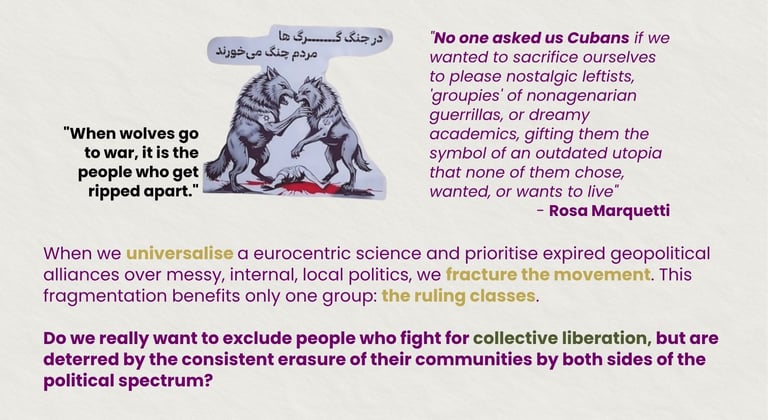
By addressing immediate socio-ecological survival and building pluralistic solidarity, we prevent the movement from fracturing to the sole benefit of the ruling classes.

The quest for liberation within post-colonial and occupied geographies is frequently hijacked by the very structures it claims to oppose. When revolutionary movements lack a rigorous, localised materialist analysis, they inevitably fall into the traps of state-centric binaries, performative solidarity, and ethnonationalist hegemony. This phenomenon often manifests within a "colonial left" that reproduces dogma and worship rather than critical thinking, forcing lived experiences into contrived ideological boxes. By reading Muzan Alneel’s materialist critique of the Sudanese revolution alongside a decolonial framework for Cyprus, a striking alignment emerges. Both contexts reveal how nationalist organising - whether operating under the guise of state sovereignty or anti-imperialist rhetoric - replicates colonial logics, erases internal violence, and actively undermines the material self-determination of the people.
The Material vs. The Metaphysical: Deconstructing "Nation-First" Hegemony
A primary mechanism of nationalist organising is the subordination of concrete material struggles to an abstract, idealised concept of the nation. In her analysis of Sudan, Muzan Alneel highlights how Omar al-Bashir’s regime deployed a "Sudan-first" narrative to mask the devastating human cost of its neoliberal economic policies. By prioritising state sovereignty and national pride as metaphysical absolutes, the regime successfully obscured its systemic failure to distribute resources equitably, framing economic deprivation as a necessary sacrifice for the fatherland.
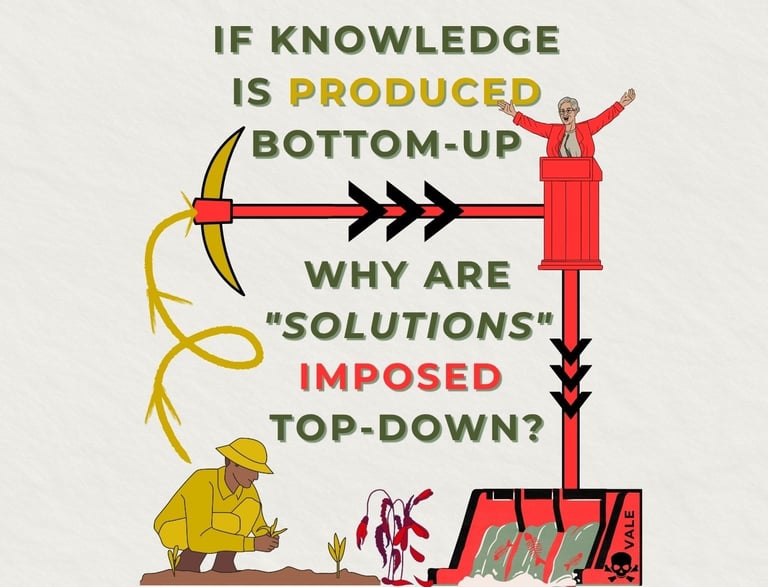
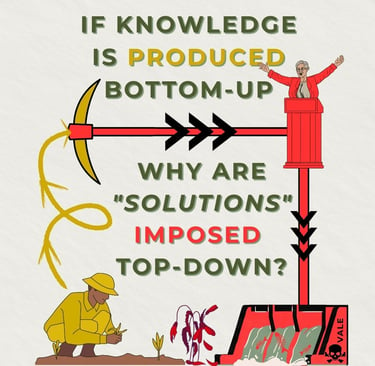
This dynamic reveals a broader crisis in leftist spaces, where there is often a stronger loyalty to states and the activist's role than to the actual people living inside those states. While struggles and knowledge are organically articulated from the bottom up, so-called revolutionary "solutions" are frequently imposed from the top down. In these spaces, "revolution" is dictated by non-situated individuals who do not face the consequences, while racialised and non-conforming women and girls are placed on a sacrificial mantle.
This precisely parallels the dominant strains of Cypriot nationalist organising. The ubiquitous slogan "Cyprus for Cypriots" may be perceived as a radical call for national self-determination, but functions as an exclusionary, ethnonationalist tool which forecloses the possibility of pluralistic co-existence and justice. By elevating a romanticised, homogenous vision of a singular "Cypriot" identity, nationalist organisers systematically ignore the distinct material conditions, class disparities, and historical traumas of the island’s diverse communities. In both Sudan and Cyprus, "nation-first" rhetoric simply speaks to foreign imperialists on their terms, instead of ours. It functions as a class-blind smoke screen, protecting internal elites and state structures from materialist critiques by demanding absolute ideological alignment with an abstract state project.

The Foreign Bogeyman and the Erasure of Internal Violence
To maintain this metaphysical hegemony, nationalist organisers must externalise all systemic failures, transferring domestic material contradictions into the realm of geopolitics. Alneel documents how the Sudanese regime routinely framed internal protests against unjust development and state violence not as valid domestic grievances, but as subversion orchestrated by a Western or Zionist "foreign bogeyman". By transforming a material class struggle into a metaphysical battle between revolutionary Islam and Western imperialism, the state sought to delegitimise grassroots resistance and evade internal accountability.
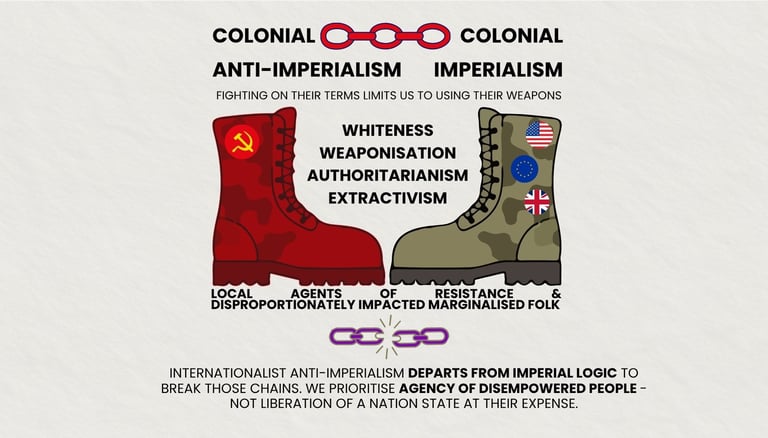
In Cypriot nationalist organising, this externalisation manifests as a rigid, binary fixation on the Turkish occupation, which serves to diminish the historical and ongoing violence perpetrated by the domestic state apparatus and all the other occupiers (U.K, U.S, Greece, Israel). By relying on a lazy tendency to simply invert imperialist logic rather than departing from it entirely, this framework results in a "colonial anti-imperialism". Fighting on these terms limits movements to utilising the exact same weapons as their oppressors: whiteness, epistemic supremacy, authoritarianism, and extractivism.
Nationalist narratives rightly highlight Turkey’s imperial crimes, military presence, and settler-colonial policies. However, they weaponise this external threat to systematically minimise, justify, or entirely erase the violence committed under the banner of the Republic of Cyprus (RoC) and right-wing Greek Cypriot ethnonationalists. By rendering the historical ethnic cleansing, systemic marginalisation, and fascist violence of the Enosis movement invisible, nationalist organisers construct a flawless victimhood. Consequently, the internal structural violence of the RoC remains unexamined, Turkish Cypriots are dehumanised, and the possibility of a genuinely decolonised, shared future is sacrificed to maintain a clean, nationalist binary.

Epistemic Extractivism and the Spectacle of Solidarity
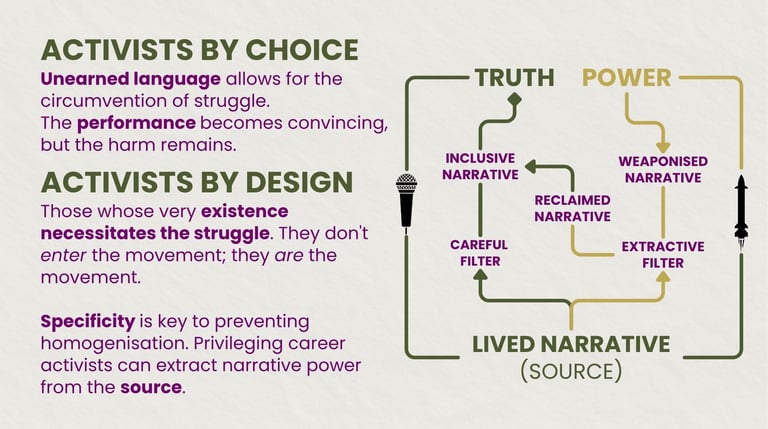
When localised organising lacks the vocabulary to articulate its own material realities, it often resorts to co-opting global struggles for social capital - a process Alneel critiques as "trendifying" the revolution. In these environments, access to unearned language allows individuals to circumvent the actual struggle that formed the articulation, resulting in a convincing performance while the underlying harm remains. This dynamic privileges "activists by choice" - career activists who co-opt oppression for social capital - over "activists by default," whose very existence necessitates the struggle.
Cypriot nationalist and performative leftist spaces are deeply entrenched in this form of epistemic extractivism. A glaring example is the contemporary tendency within these groups to equate the Turkish Republic of Northern Cyprus (TRNC) to the State of Israel, mapping the Palestinian experience directly onto the Cypriot division. Now, how is this colonial?
Rhetorical weaponisation: The language of "apartheid," "settler-colonialism," and "occupation" is extracted from the Palestinian context and applied as a blanket aesthetic to Cyprus. By privileging career activists, this process extracts narrative power directly from the lived experiences of the source.
Erasure of particularity: This extraction violently simplifies the Cypriot reality, ignoring the localised history of intercommunal conflict, constitutional collapse, and fascist coups that preceded the 1974 partition. Homogenisation is fundamentally a tool of colonialism, meaning specificity and deep contextualisation are vital to prevent the overrepresentation of one specific knowledge system.
Harm to both struggles: It reduces the ongoing genocide and systemic displacement of Palestinians to a convenient rhetorical tool while forcing Cypriot organisers to operate within a borrowed framework that cannot account for the material truths of their own island.
The Performative Left and Dogmatic Vanguardism
Ultimately, the absence of a materialist framework leaves organising vulnerable to a dogmatic, performative vanguardism that excludes activists by default in favour of activists by choice. In Sudan, portions of the traditional left engaged with the revolution through an inverted mainstream lens, prioritising ideological purity and international spectacles over the grueling, unglamorous work of communal service provision and grassroots mutual aid.
In Cyprus, this performative failure is perfectly embodied by dogmatic nationalist groups operating with a pervasive elitism. They readily dismiss the survival instincts of the masses because grassroots actions do not resemble formal, institutionalised labour politics - a mindset that is deeply exclusive, hegemonic, and condescending. For many communities, contentious action exists precisely where their agency is consistently challenged; whether it is Cypriots speaking their dialect or Palestinians planting olive trees, reclaiming dignity is a profoundly contentious and vital step in the liberation process.
Rather than engaging in genuine community building or analysing the shifting socio-ecological realities of the island, these factions rely on a monolithic, top-down nationalism. Their organising exists almost exclusively in the realm of discourse and digital spectacle, demanding an unconditional return to a romanticised pre-1974 status quo. However, true sustainable action in Cyprus is not spectacular; it requires meeting people where they are, distributing emotional labour, and cultivating alternatives that replace the roles of imperialists and local elites.